Over 20% of the UK population has insufficient vitamin D levels. Many Brits reach for vitamin D3 supplements during grey winters, but fewer realise there’s a nutrient often discussed alongside it: vitamin K2.
These two nutrients are studied together in relation to bone health and cardiovascular wellbeing. Research suggests that without adequate K2, vitamin D3 supplementation may not deliver its full potential benefit for bone health specifically — though, as covered below, this is a genuinely developing area of research rather than a fully settled picture.
This guide explores what the evidence actually shows about combining D3 and K2, who might reasonably consider it, and which UK supplements offer good quality and value.
What Is Vitamin D3 and Why Does It Matter?
Vitamin D3 (cholecalciferol) is often called the “sunshine vitamin” because the body produces it naturally on sun exposure. It plays several recognised roles: supporting calcium absorption from the digestive tract, contributing to normal immune system function, contributing to normal muscle function and cell growth, and it’s also studied in relation to mood regulation.
The UK’s northern latitude means limited sun exposure for adequate vitamin D production, particularly between October and March. Vitamin D3 helps the body produce proteins that regulate calcium levels — but these proteins require vitamin K2 to become fully active. Without adequate K2, the calcium made more available by vitamin D may not be as effectively directed toward bones, and some research suggests it could instead accumulate in soft tissues or arteries — an area of genuine research interest, though the practical significance for any individual varies and isn’t fully mapped out yet.
What Is Vitamin K2 and What Does It Do?
Vitamin K1 (found in leafy greens) is primarily associated with blood clotting. Vitamin K2 performs a different, complementary role: activating proteins that help regulate where calcium is directed in the body — osteocalcin helps bind calcium to the bone matrix, while Matrix Gla Protein (MGP) is studied for a role in helping prevent calcium from depositing in soft tissues like arteries and kidneys, a process researchers associate with arterial stiffness and plaque formation.
K2 comes in two main forms. MK-4 is found in animal products like eggs and meat, with a relatively short half-life in the body. MK-7, found in fermented foods like natto (fermented soybeans), has a longer half-life — remaining active for up to around 72 hours — and generally higher bioavailability, which is why it’s the more commonly used form in daily supplements. Unlike vitamin D, which the body synthesises from sunlight, K2 must come from diet or supplements, and typical Western diets — including a typical British diet — tend to be relatively low in it.
The Evidence: What Research Actually Says
“Current evidence supports the notion that joint supplementation of vitamins D and K might be more effective than the consumption of either alone for bone and cardiovascular health.” — 2017 review, International Journal of Endocrinology
The same researchers were also direct about the limits of current knowledge: “Future studies are needed to determine whether vitamin D combined with vitamin K rich foods or vitamin K supplementation could improve bone and cardiovascular health.” This honest caveat matters, and it’s worth keeping in mind throughout the rest of this guide.
On the positive side, postmenopausal women taking K2 and D3 together for more than a year showed improved bone mineral density and bone quality compared with either nutrient alone, a modest synergistic effect was observed after 2 years in a study of healthy older women, and adding vitamin K to vitamin D and calcium in postmenopausal Korean women increased bone mineral density and reduced uncarboxylated osteocalcin (a marker of vitamin K status) after 6 months. That said, genuine limitations are worth knowing too: many of the supporting studies have small sample sizes, long-term safety data is still developing, and there’s no established cut-off value for vitamin K status, nor a single agreed optimal supplementation level.
Why K2 Is Often Discussed Alongside D3
Taking vitamin D3 increases how much calcium the body absorbs from food — generally a good thing, but it raises a reasonable question about where that additional calcium actually goes. Some research has explored whether vitamin D supplementation without adequate K2 might be associated with a greater share of calcium being directed to arterial walls rather than bone, increased arterial stiffness in some studies, and a possible link to kidney stone formation in some research.
One study found that adults with both low vitamin D and low vitamin K levels appeared to have a higher risk of a cardiovascular event, with researchers proposing that calcification (hardening) of blood vessels might be part of the explanation — this is an association from observational research, not proof of a direct causal chain, and it’s an area that would benefit from larger, more definitive trials. A commonly used analogy: vitamin D3 helps calcium enter the bloodstream, while K2 is studied for a role in helping direct that calcium toward bone rather than soft tissue.
Potential Benefits of Taking D3 and K2 Together
For bone health, D3 supports calcium absorption while K2 is studied for activating osteocalcin, which helps incorporate calcium into bone tissue — some clinical studies suggest D3 and K2 together may support bone mineral density more than either alone, particularly in older adults, though this research base is still developing, as the limitations above note.
On the cardiovascular side, K2 is studied for activating MGP, which may help reduce calcium deposition in arteries. The Rotterdam Study, a large observational study following around 4,800 participants over 7-10 years, found that higher dietary K2 intake was associated with lower rates of arterial calcification and cardiovascular mortality — a notable finding, though it reflects dietary intake patterns rather than a controlled trial of supplementation specifically, a meaningful distinction.
Immune-related research is more one-sided: vitamin D has a well-established, EU-authorised role in normal immune function, while K2’s role here is considerably less established — some research has explored its influence on T-cell activity and inflammation-related processes, but this is a much earlier-stage, less settled area than D3’s immune role, and shouldn’t be read with the same confidence. Finally, as fat-soluble vitamins, D3 and K2 are generally better absorbed when taken with a meal containing some fat, which is a practical reason some people choose combined formulations.
Who Might Consider D3 + K2 Together?
Most people in the UK could reasonably consider vitamin D supplementation during winter months at minimum, but the K2 combination is a more specific consideration for several groups: people with limited sun exposure (the majority of the UK population for much of the year, given our latitude and weather); adults over 40, as calcium metabolism changes and bone density naturally declines with age, though this is a general consideration rather than something that applies uniformly to everyone in this age bracket; women in perimenopause or menopause, given declining oestrogen after around age 50 is linked to accelerated bone density loss, with the International Osteoporosis Foundation including both vitamin D and K among nutrients worth considering at this life stage; and vegans and vegetarians, since plant-based diets often provide limited natural D3 and K2.
Anyone with a family history of osteoporosis or heart disease is worth discussing this with a GP specifically, who can advise on whether targeted supplementation makes sense for your situation rather than assuming it applies uniformly. And anyone on higher-dose vitamin D (over 2,000 IU daily) should discuss this with their GP regardless of whether they add K2, since higher-dose vitamin D should generally be medically supervised — K2 is not a substitute for that supervision.
Choosing a D3 + K2 Supplement in the UK
When choosing a combined supplement, look for the MK-7 form of K2 (generally better bioavailability than MK-4), minimal unnecessary fillers, doses within commonly researched ranges (roughly 400-4,000 IU D3 and 75-200mcg K2), and an oil-based or emulsified formulation to support absorption of these fat-soluble nutrients.
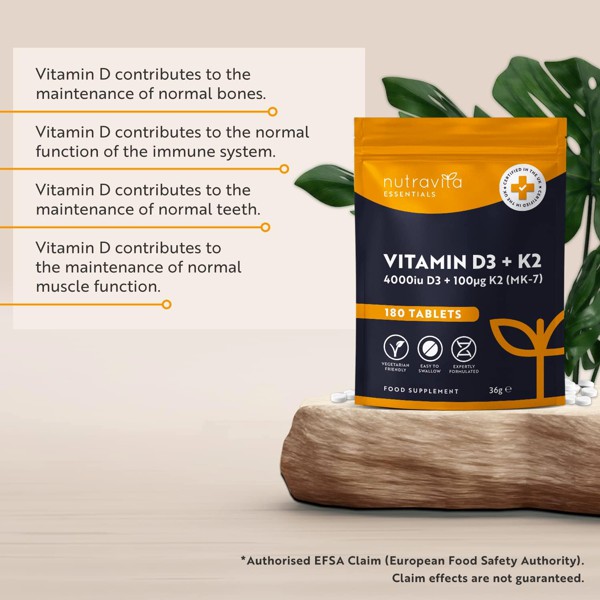
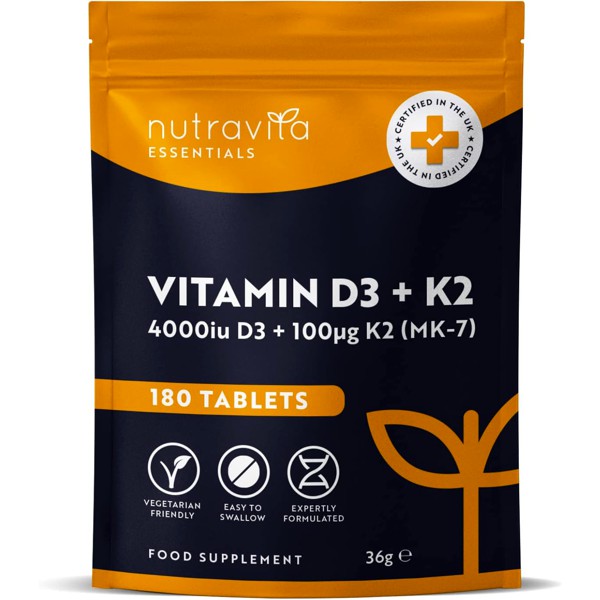
Nutravita’s Vitamin D3 + K2 (MK7) is UK-manufactured, offering 4,000 IU vitamin D3 with 100mcg K2 as MK-7, free from common allergens (gluten, dairy, nuts), with 180 easy-to-swallow tablets manufactured to GMP standards.
Multivitamins
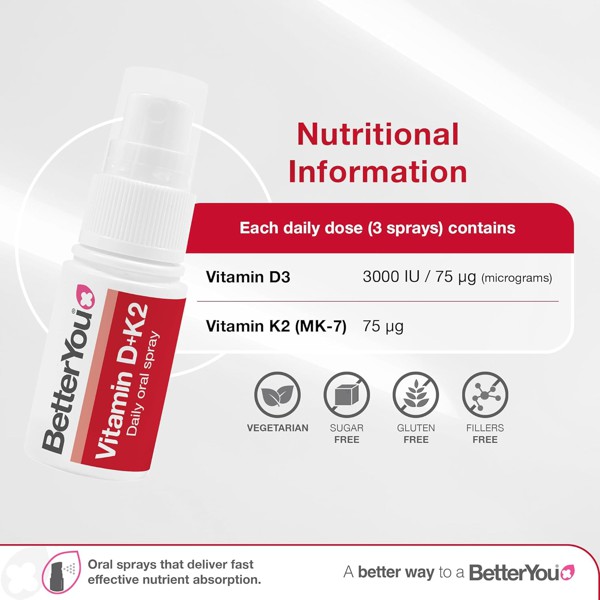
For those who prefer not to swallow pills, BetterYou’s D3000 + K2 Oral Spray delivers vitamin D3 (3,000 IU) and K2 (75mcg) via the mouth’s mucous membrane — a portable format with a natural peppermint flavour, approved by the Vegetarian Society.

Multivitamins
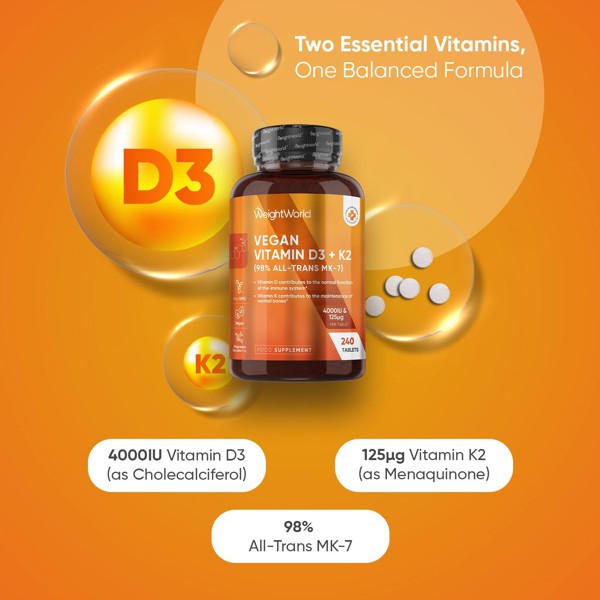
WeightWorld’s High Strength D3+K2 Capsules offer a budget-friendly option with 4,000 IU D3 and 125mcg K2 as MK-7, 240 vegan-friendly tablets (roughly a year’s supply), third-party tested for purity.

Multivitamins
How to Take D3 + K2
For vitamin D3, the NHS recommends 10mcg (400 IU) daily for general maintenance, while those with limited sun exposure often take 1,000-4,000 IU, ideally under clinical guidance rather than self-selected at the higher end. For K2 (as MK-7), some studies use around 180mcg daily in relation to bone health markers, a commonly referenced general range is 75-200mcg daily, and trials examining cardiovascular-related outcomes have generally used doses between 90-360mcg — there’s no single, universally agreed “correct” dose for K2 specifically, and these ranges reflect what’s been used in research rather than a fixed prescription.
Since both are fat-soluble, taking them with a meal containing some fat improves absorption — breakfast or dinner are convenient choices for most people. Magnesium is worth a mention here too, since it plays a role in activating vitamin D in the body, making adequate magnesium status a reasonable complementary consideration alongside D3+K2.
A few groups should check with a GP before starting: anyone taking blood-thinning medication, especially warfarin, since vitamin K can reduce its effectiveness and dosing may need to be stabilised and monitored by a doctor; people with certain kidney conditions; anyone with high calcium levels or hypercalcaemia; and those with specific liver conditions.
D3+K2 is generally well tolerated by most healthy adults at recommended doses — side effects such as nausea, weakness, or stomach discomfort are more commonly associated with prolonged, very high doses of vitamin D3, well above the standard 10mcg guideline, rather than typical supplement doses. Excessive vitamin D can lead to hypercalcaemia, which can in turn affect kidney function; K2, meanwhile, doesn’t carry the same toxicity profile at typical doses, but specifically requires caution alongside warfarin, as noted above. As with most supplements, consistency matters more than any single dose — bone-related changes, where studies have found them, generally take 3-6 months of consistent use to become measurable, so this isn’t a supplement with a fast, noticeable effect.


Vitamins & Minerals
Common Myths
Myth: “I eat plenty of green vegetables, so I don’t need K2.” Leafy greens contain vitamin K1, which is valuable for blood clotting but doesn’t perform the same calcium-directing role as K2 — they’re related but functionally distinct.
Myth: “Taking calcium with D3 is enough for bone health.” Without adequate K2, some research suggests the calcium made available by vitamin D may not be as effectively directed to bone tissue — though, as covered throughout this guide, the practical significance of this for any given individual isn’t fully established.
Myth: “I only need vitamin D during winter.” Vitamin D deficiency is more common in darker months, but many UK residents run low year-round given our latitude, indoor lifestyles, and generally overcast weather.
Myth: “Higher doses of vitamins are always better.” Not true — more isn’t automatically better, and very high vitamin D doses without adequate K2 (or medical supervision) may carry more risk than benefit. Stick to researched dosage ranges, and check with your GP before going beyond standard maintenance doses.
Being Honest About the Limitations
The positive research above is genuinely encouraging, but it’s worth repeating the field’s own acknowledged limitations directly: “Future studies are needed to determine whether vitamin D combined with vitamin K rich foods or vitamin K supplementation could improve bone and cardiovascular health,” and “No cut-off value for vitamin K status nor vitamin K supplementation is available yet.”
Reasonably well-supported: bone mineral density improvements when D3 and K2 are combined, particularly in postmenopausal women; reduced uncarboxylated osteocalcin (a marker of vitamin K status) with supplementation; and good tolerability at standard, researched doses.
Preliminary or still developing: the optimal dosing ratio between D3 and K2; long-term cardiovascular outcomes specifically from supplementation (the dietary observational data is more established than the supplementation trial data); and the best form and timing for different population groups.
Final Thoughts
The research on combining vitamin D3 and K2 is genuinely interesting and, for bone health specifically, reasonably supportive — but it’s more accurate to describe this as a promising, still-developing area than a settled, “proven” upgrade over D3 alone. The researchers behind the studies cited throughout this guide are themselves clear that more work is needed, particularly for long-term cardiovascular outcomes.
Given the UK’s limited sunlight, vitamin D supplementation makes sense for most people, especially in winter. Adding K2 is a reasonable, generally low-risk choice for many people interested in the bone-health angle specifically — but it’s not a guaranteed fix, and it doesn’t replace medical guidance if you have a relevant health condition or take medication, particularly warfarin.
Before starting any new supplement regimen, particularly if you have an existing health condition or take medication, speak to your GP or a registered dietitian, who can advise on the right approach for your specific situation.
Disclaimer: This article is for informational purposes only and does not constitute medical advice. Always consult your GP before starting any new supplement, particularly if you take blood-thinning medication, have kidney or liver conditions, or have high calcium levels.